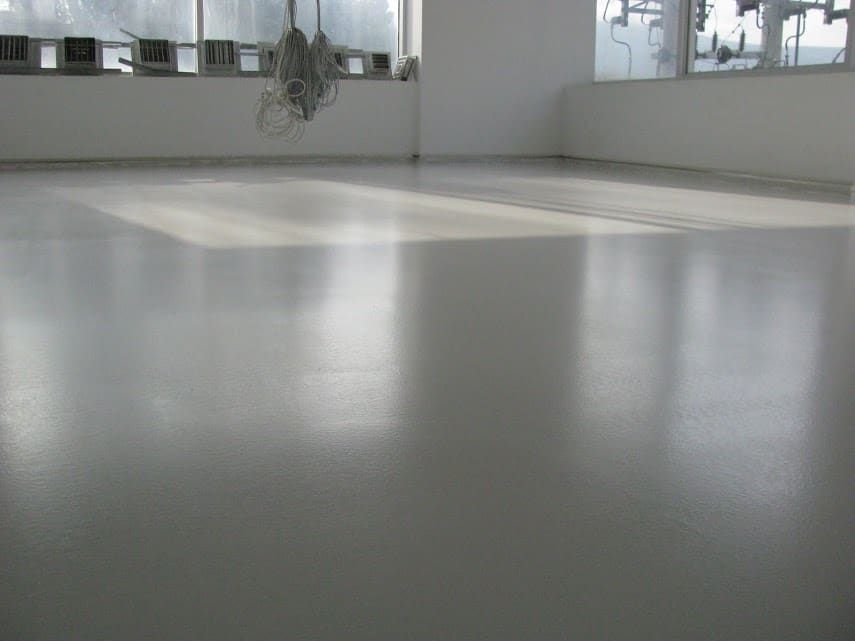
Floor coatings
Polyurethane resin floors
A more flexible resin, valued for colour stability and as a protective topcoat.
Polyurethane resin complements epoxy in many floor systems. More flexible, it copes better with some substrate movement and generally keeps its colour better in light.
It is used as a complete coating or as a topcoat over epoxy, especially for sun-exposed areas, ramps and spaces where looks matter.
Applications
- Protective topcoat over epoxy floors
- Areas exposed to daylight
- Ramps and semi-open car parks
- Shops and public spaces
- Floors with slight movement
Polyurethane resin
How we work
System selection
PU alone or as topcoat on epoxy according to use and exposure.
Substrate preparation
Mechanical preparation and repairs.
Primer
Primer suited to the chosen system.
PU coats
Roller or squeegee application, with anti-slip aggregates if needed.
Curing
Curing times respected before return to service.
Benefits
Better colour stability in light (product-dependent)
More flexible than epoxy
Matt or satin finishes
Compatible with epoxy systems
Gallery
Polyurethane resin — in pictures
Frequently asked questions
Epoxy or polyurethane: which to choose?
Epoxy is hard and economical indoors; polyurethane is more flexible and more UV-stable. They are often combined: epoxy base, PU topcoat.
Is polyurethane suitable for car parks?
Yes, especially as a topcoat on exposed areas and ramps, with anti-slip aggregates.
Can PU be applied over an old epoxy floor?
Yes after sanding and cleaning, if the existing epoxy is well bonded.
Further reading
Related services



Quote request
Free and with no obligation. We usually reply within 2 business days.
- 1. Project
- 2. Details
- 3. Contact